Religious Education
To Know You More Clearly
Our Religious Education curriculum is rooted in the Religious Education Directory (RED) Model Curriculum from the Catholic Bishops’ Conference of England and Wales. It follows the six-branch model, with each branch taught across the academic year and carefully aligned with the Liturgical Year. This structure enables pupils to develop their knowledge and understanding of Scripture, Catholic teaching and the life of the Church in a clear and progressive way.
The six branches are:
- Advent 1 – Creation and Covenant
- Advent 2 – Prophecy and Promise
- Lent 1 – Galilee to Jerusalem
- Lent 2 – Desert to Garden
- Pentecost 1 – To the Ends of the Earth
- Pentecost 2 – Dialogue and Encounter
This approach provides a coherent journey through the Catholic faith, allowing pupils to revisit and deepen their understanding of key theological concepts, Scripture and Catholic traditions as they progress through the school.
Ways of Knowing: Understand, Discern and Respond
The three Ways of Knowing – Understand, Discern and Respond – describe the skills and processes that pupils develop as they progress through Religious Education. They work alongside the Knowledge Lenses to ensure that pupils are not simply acquiring knowledge, but are learning how to make sense of it, reflect upon its meaning and consider how it influences their lives.
Understand enables pupils to develop a secure and increasingly deep knowledge of Scripture, Catholic teaching, beliefs, traditions and the wider religious and worldview context. Pupils learn to make connections between different aspects of their learning and develop appropriate theological vocabulary.
Discern encourages pupils to reflect, question and explore the meaning and significance of what they have learned. They consider different perspectives, make links between faith and their own experiences, and develop the ability to think critically and thoughtfully about religious and moral questions.
Respond enables pupils to apply their learning and reflect on how faith can be lived out. Pupils are encouraged to articulate their own responses, make informed choices and consider how Catholic beliefs and values can shape their relationships, actions and responsibilities towards others and the world.
Knowledge Lenses
The Knowledge Lenses provide the framework for what pupils encounter and study within the Religious Education curriculum. They identify the essential knowledge that pupils should develop and retain as they progress through each age phase. The lenses act as a way of looking at the content of Religious Education, ensuring that pupils experience a broad and balanced understanding of Catholicism alongside opportunities to learn about other religions and worldviews.
For the study of Catholicism, the four Knowledge Lenses are:
- Hear – encountering Scripture and the Word of God, exploring biblical stories, people, events and messages.
- Believe – developing knowledge and understanding of Catholic beliefs, teachings and doctrine, and exploring what Catholics believe and why.
- Celebrate – exploring how faith is expressed through prayer, worship, liturgy, the Sacraments, the Liturgical Year and the traditions of the Church.
- Live – considering how Catholic faith is lived out through relationships, moral choices, service, stewardship, justice and care for others.
The study of other religions and worldviews is supported through the additional lenses of Dialogue and Encounter. These enable pupils to develop an understanding of different religious and non-religious perspectives, appreciate diversity and engage respectfully with the beliefs and experiences of others.
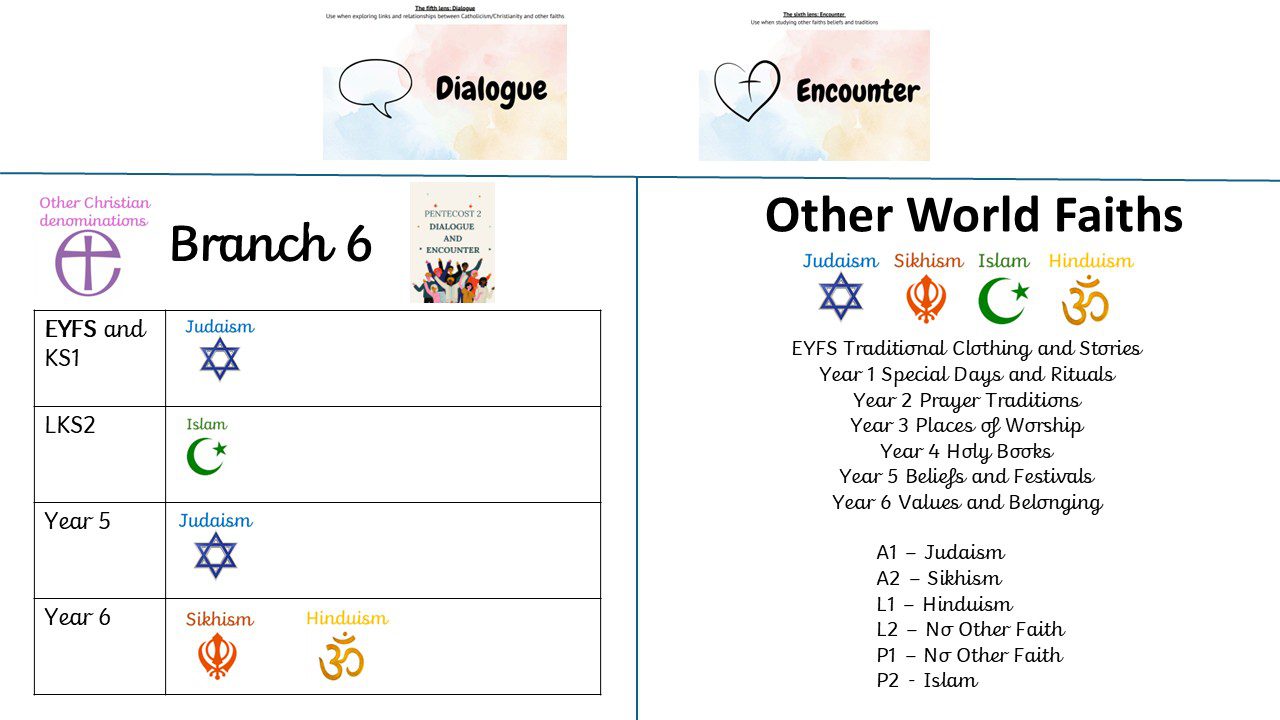
Together, the six Knowledge Lenses provide the content pupils need to know, while the three Ways of Knowing – Understand, Discern and Respond – develop the skills pupils need to engage meaningfully with that knowledge. This ensures that Religious Education at St Joseph’s develops pupils who can know their faith, think deeply about it, and consider how they can live it out.